we will systematically break down the 7 core reasons why...
Read MoreTraining and education UAV Drone Energy Solution
- Home
- /
- Solutions
- /
- UAV Drone Solutions
- /
- Training and Education UAV...
Training and education drones are designed for beginner-level flight instruction, basic operation courses, safety training, and entry-level aerial practice. These drones are typically simple, durable, easy to maintain, and highly user-friendly—making them ideal for flight schools, educational institutions, and corporate training programs.
For training and educational drones, having the right battery is essential. A stable, safe, and long-cycle battery ensures uninterrupted lessons, reduces maintenance needs, and supports continuous practice for students. High-quality batteries offer longer flight time, stronger safety protections, and greater durability across repeated charge–discharge cycles. This helps institutions minimize downtime, improve training efficiency, and provide a more reliable learning experience.
UAV Weight Classification and License Category Specifications
U.S. (FAA) Regulations
1. Registration Requirements by Weight
Under specific exceptions, UAVs used for recreational or basic educational purposes may be exempt from registration, but this exemption does not apply to flight operations under Part 107.
Weight < 0.55 lbs (250 g): Exempt from registration (for recreational/educational use only); Part 107 rules still apply for other operations.
Weight 0.55 lbs (250 g) ~ 55 lbs: Mandatory registration with the FAA for both recreational and commercial use; requires an amateur or commercial UAV operation certificate.
Weight > 55 lbs: Complex registration process due to higher hazard risks; additional flight authorizations required.
2. License Requirements
Recreational Operators: Must comply with the TRUST (Recreational UAS Safety Test) guidelines and community rules; applies to non-commercial flights.
Commercial Operators: Must hold a Part 107 Remote Pilot Certificate (requires age, language proficiency, and aeronautical knowledge exam). All commercial UAVs must be registered, regardless of weight.
EU (EASA) Regulations
1. Classification for Multirotor UAVs & Low-Risk Commercial Scenarios
Subdivided by weight and flight conditions:
Subclass A1: Applicable to UAVs < 250 g (Class C0) or Class C1 UAVs < 900 g. Operators must complete basic training or read the manual; avoid populated areas during flight.
Subclass A2: Applicable to Class C2 UAVs < 4 kg. Operators must hold a remote flight capability certificate; comply with strict safety distances from people.
Subclass A3: Applicable to large UAVs (Class C3/C4 or unclassified UAVs < 25 kg). Avoid populated/sensitive areas; mandatory registration and online training.
2. Special Categories & Certification Rules
Applicable to high-risk operations (e.g., BVLOS flight, passenger transport, hazardous material transport):
Requires detailed risk assessments and special operation authorizations.
Comprehensive certification of UAV equipment, operators, and units may be mandatory.
Recommended solutions
overview
Battery selection prioritizes endurance, safety, and reliability:
– Semi-solid state batteries: For regular training.
– HV batteries: To improve efficiency and stability.
High-Discharge LiPo Battery Solution
Suitable for: Multirotor teaching drones, entry-level training drones, and frequently used instructor-led training drones.
Recommended Parameters:
Voltage: 6S (14.8–22.2V)
Capacity: 10,000–22,000 mAh
Continuous C-rate: 15C–30C
Features: Stable output, flat voltage platform, ideal for frequent takeoff/landing training.
Model | Capacity | Voltage | Discharge Rate | Energy | Charge Cut-off Voltage | Discharge Cut-off Voltage | Weight | Dimensions (T*W*L mm) |
ENP120006S25-HCR | 12000mAh | 6S 22.8V | 25C | 266.4Wh | 25.2V | 21.6V | 1608.6g(±15g) | 53*74*180 |
ENP160006S25-HCR | 16000mAh | 6S 22.8V | 25C | 355.2Wh | 25.2V | 21.6V | 2076.6g(±15g) | 71*74*180 |
ENP220006S25-HCR | 22000mAh | 6S 22.8V | 25C | 488.4Wh | 25.2V | 21.6V | 2560g(±15g) | 64*90*200 |
Semi-Solid State Battery Solution
Suitable for: Long-hour teaching, inspection training, and scenarios requiring durability and cycle life.
Recommended Parameters:
Series (S): 4S–8S (matching airframe)
Capacity: 10,000–25,000 mAh
Continuous C-rate: 8C–15C
Features: High energy density (long endurance), safer, long cycle life.
280 Wh/kg Normal Pressure Semi-Solid State Battery
Model | Capacity | Voltage | Discharge Rate | Energy Density | Dimensions (T*W*L mm±5%) | Weight(g±5%) |
ENP160006S10-HCS | 16000mAh | 6S 22.2V | 10C | 280Wh/kg | 125.5*74*180 | 1440 |
ENP170006S10-HCS | 17000mAh | 6S 22.2V | 10C | 280Wh/kg | 125.5*74*180 | 1500 |
ENP220006S10-HCS | 22000mAh | 6S 22.2V | 10C | 280Wh/kg | 146.5*74*180 | 1915 |
ENP250006S10-HCS | 25000mAh | 6S 22.2V | 10C | 280Wh/kg | 82.5*107*240 | 2390 |
ENP270006S10-HCS | 27000mAh | 6S 22.2V | 10C | 280Wh/kg | 139.5*89*200 | 2340 |
280 Wh/kg High-Voltage Semi-Solid State Battery
Model | Capacity | Voltage | Discharge Rate | Energy Density | Dimensions (T*W*L mm±5%) | Weight(g±5%) |
ENP170006S10-HCS | 17000mAh | 6S 23.7V | 10C | 280Wh/kg | 57.5*74*180 | 1660 |
ENP200006S10-HCS | 20000mAh | 6S 23.7V | 10C | 280Wh/kg | 51.5*89*200 | 1980 |
ENP250006S10-HCS | 25000mAh | 6S 23.7V | 10C | 280Wh/kg | 63.5*89*200 | 2380 |
High-Voltage / High-Energy LiPo (LiHV) Solution
Suitable for: Educational institutions pursuing higher efficiency and longer flight times.
Recommended Parameters:
Series (S): 4S–6S
Capacity: 10,000–25,000 mAh
Continuous C-rate: 10C–25C
Features: Higher energy than traditional LiPo, flat voltage platform, more stable flight.
Suitable Scenarios: Flight training, stable flight teaching, enhanced endurance training.
Model | Capacity | Voltage | Discharge Rate | Energy | Charge Cut-off Voltage | Discharge Cut-off Voltage | Weight | Dimensions (T*W*L mm) |
ENP160004S25-HV | 16000mAh | 4S 15.2V | 25C | 243.2Wh | 17.4V | 14.8V | 1206.6g(±15g) | 41.2*74*180 |
ENP160006S25-HV | 16000mAh | 6S 22.8V | 25C | 364.8Wh | 26.1V | 22.2V | 1810g(±15g) | 60.8*74*180 |
ENP220004S25-HV | 22000mAh | 4S 15.2V | 25C | 334.4Wh | 17.4V | 14.8V | 1633.3g(±15g) | 41.2*90*200 |
ENP220006S25-HV | 22000mAh | 6S 22.8V | 25C | 501.6Wh | 26.1V | 22.2V | 2450g(±15g) | 60.8*90*200 |
ENP250004S25-HV | 25000mAh | 4S 15.2V | 25C | 380Wh | 17.4V | 14.8V | 1684g(±15g) | 45.2*90*200 |
ENP250006S25-HV | 25000mAh | 6S 22.8V | 25C | 570Wh | 26.1V | 22.2V | 2526g(±15g) | 66.8*90*200 |
CONTACT US
If you would like to inquire about product pricing, place an order, or have any other questions, please feel free to fill out the form or contact us through the following methods.
Keep in touch
General process
Step 01
Inquiry & Requirement Confirmation
Step 02
Quotation & Payment
Step 03
Production & Quality Control
Step 04
Logistics & Tracking
Step 05
Customs Clearance Assistance
Step 06
Feedback & Follow-up
Battery source
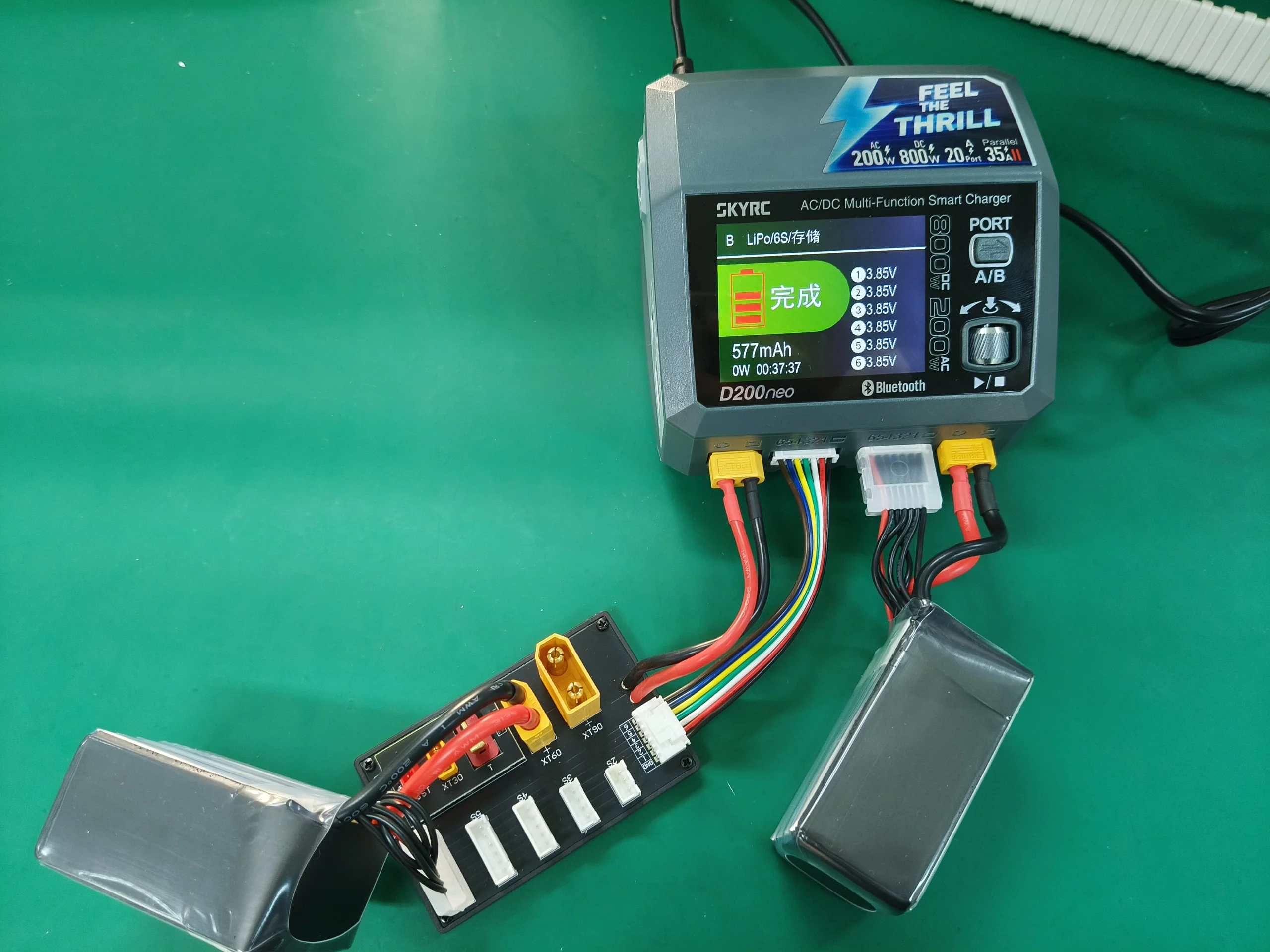
How to Charge Batteries? (Detailed Step-by-Step Guide)
Proper and safe battery charging and maintenance are critical aspects...
Read More
Stop Guessing! Master Drone Battery Endurance Calculation in 5 Minutes – Fly Longer Every Time!
This guide details how to calculate drone battery (especially Lipo...
Read More