.webp)
When drone technology collides passionately with competitive sports, an emerging sport that combines a sense of technology and ornamental value—Drone Soccer—is quietly gaining popularity. It breaks the ground limitations of traditional soccer, integrating precise control, team collaboration, and technological power. It not only brings a new experience to sports enthusiasts but also becomes an important scenario for the practical application of drone technology. Behind this airborne competition, the performance of the power battery directly determines the rhythm and outcome of the game, serving as an indispensable core support.
I. What is Drone Soccer? Airborne Competition in 3D Space
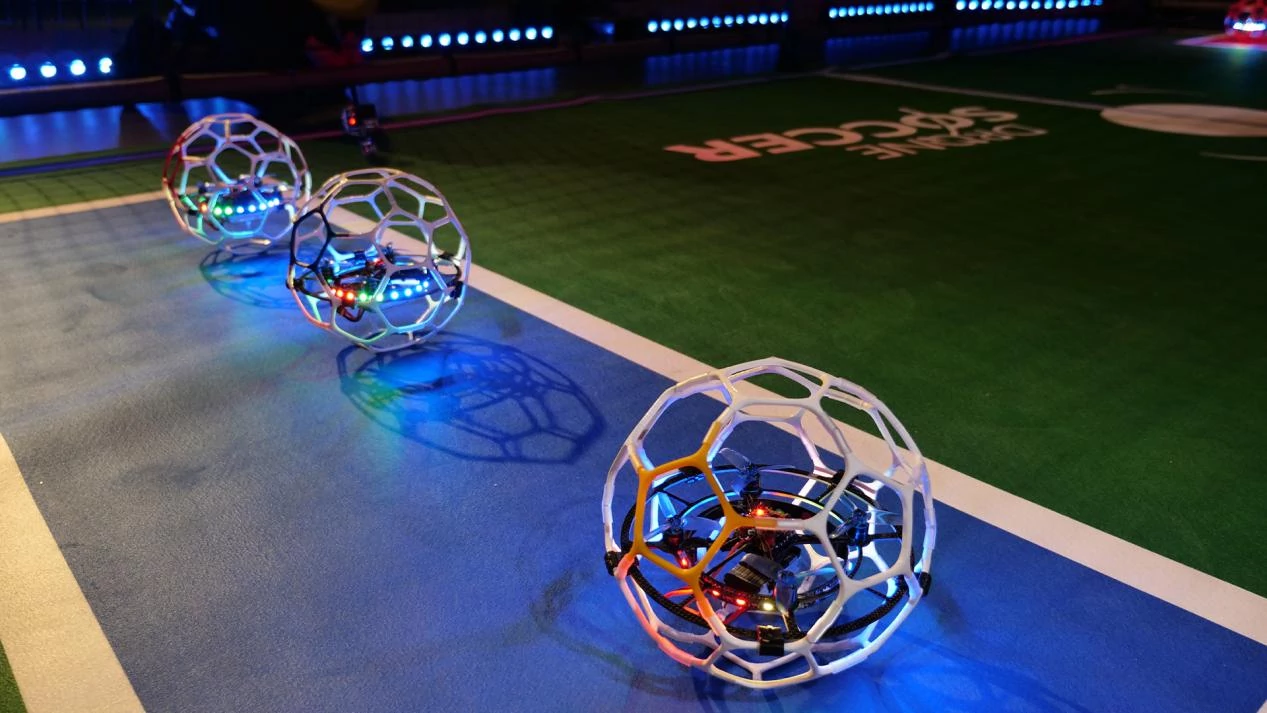
Drone Soccer is a 3D airborne competitive sport based on drone formation flight and team confrontation, with core gameplay that combines the dual characteristics of “technological control” and “competitive sports”. During the game, each participating drone is enclosed in a spherical protective frame made of non-metallic materials, which is usually equipped with LED light strips. These strips not only distinguish different teams but also make the airborne confrontation more visually striking.
The game is held in an enclosed low-altitude venue. Each team consists of multiple pilots who control the drones through remote controls to complete actions such as “passing”, “intercepting”, “attacking”, and “defending”. The ultimate goal is to send the designated “ball drone” into the opponent’s goal to score points. Unlike the physical confrontation in traditional soccer, the competition in Drone Soccer is more reflected in the pilot’s control precision, tactical coordination, and the dynamic response speed of the drone equipment. It is a modern airborne sports project suitable for participants of all age groups.
II. Origin and Development: A Technological Sport Spreading from South Korea to the World
Drone Soccer originated in South Korea and was first demonstrated and promoted in 2016. Initially positioned as a casual competitive sport accessible to the public, it quickly gained a large number of enthusiasts with its unique technological charm. With the increase in participants and the improvement of the competition system, this sport has gradually moved towards professionalism and internationalization, and South Korea has become a core force promoting its global development.
Today, Drone Soccer has been launched and promoted in more than 30 countries around the world. Many countries such as the United States, Japan, China, and France have established professional teams and held local competitions. From casual entertainment to professional competition, the development trajectory of Drone Soccer also witnesses the extension of drone technology from industrial applications to the mass consumption and sports fields.
III. Competition Rules: Competitive Fairness Under Technological Norms
The competition rules of Drone Soccer are formulated by authoritative organizations such as the Fédération Aéronautique Internationale (FAI), which not only ensure competitive fairness but also take into account safety and ornamental value. According to the latest rules, the core points are as follows:
(I) Basic Competition Settings
The competition venue is an enclosed low-altitude area with a standard size of approximately 20m × 10m to avoid external interference and ensure flight safety. The number of participants in each team varies according to the category. The common F9A-A and F9A-B categories are 5-player teams, while the F9A-C category is 3-player teams. Among them, only one forward drone can be clearly distinguished by LED light strips, and only the forward is eligible to score points.
(II) Scoring and Winning/Losing Judgment
The game adopts a time-limited scoring system, and the team with more goals within the specified time wins; in case of a draw, the winner will be determined through extra time or penalty kicks. Different categories correspond to different specifications of drone equipment. For example, for the F9A-B category, the take-off weight of the drone shall not exceed 300g, and the diameter of the spherical protective frame shall be 200±20mm, ensuring the fairness of competitions in different categories.
(III) Equipment Safety Requirements
To ensure the safety of the competition, the drone must be equipped with an independent physical safety unlock switch, and the use of joystick combination unlock is prohibited; the propeller diameter shall not exceed 76mm, and the use of metal propellers and repaired propellers is prohibited; at the same time, it must be equipped with a fail-safe device that can immediately stop the motor operation after activation. Some models can also be equipped with automatic recovery systems such as “Turtle Mode” to help automatically level the drone after a crash.
IV. Core Support: How Does the Power Battery Affect the Outcome of the Game?
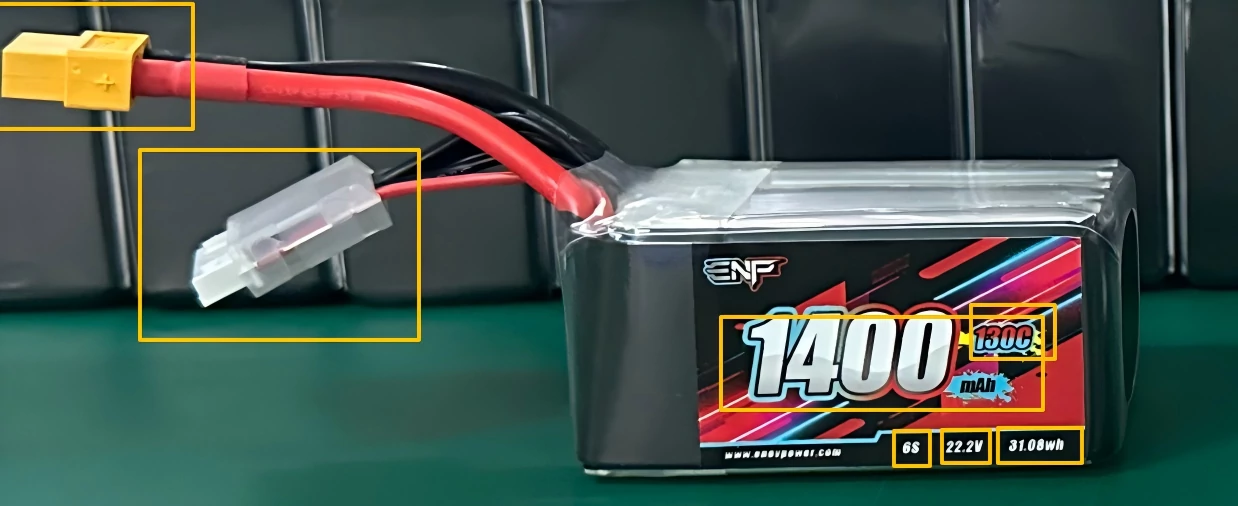
In the high-intensity confrontation of Drone Soccer, the power battery can be called the “energy heart”, and its performance directly determines the flight performance, endurance, and tactical performance of the drone. For pilots and participating teams, choosing the right battery solution is equivalent to grasping the “initiative” of the game. Combined with the competition rules and actual combat needs, the power battery must meet the following core requirements:
(I) Strict Parameter Compliance
Different categories have clear parameter restrictions on power batteries. For example, the F9A-B category requires the no-load voltage of the power battery to be ≤17V (4S), while the youth category specifies 3S, rated voltage 11.1V, and capacity ≤2000mAh. All parameter measurements allow a tolerance of 1%. Non-compliant batteries will not only lead to the cancellation of the participating qualification but also may bring potential flight safety hazards.
(II) High-Rate Discharge and Dynamic Response
In Drone Soccer competitions, high-intensity actions such as high-speed hovering, sharp turns, and assaults occur frequently, putting extremely high requirements on the discharge capacity of the battery. For example, in the 15th National Games Drone Soccer Competition, most participating teams chose power batteries with a maximum discharge rate of up to 150C, which can instantly output strong power, support the drone to achieve a maximum flight speed of 200km/h, and help pilots complete more sensitive controls and more aggressive tactical actions.
(III) Differentiated Tactical Adaptation
Professional teams will choose different battery solutions according to their tactical positioning: offensive drones need to be equipped with high-rate and lightweight batteries to reduce the weight of the fuselage while ensuring instantaneous explosive power to achieve rapid breakthroughs; defensive drones prioritize high-capacity and high-stability batteries to extend endurance and anti-interference capabilities, ensuring long-term airborne interception. This differentiated configuration of “light, fast and explosive” and “stable and durable” has become a key factor affecting the trend of the game.
(IV) Safety and Charging Efficiency Guarantee
High-intensity competitions also have strict requirements on charging efficiency. The 8-channel intelligent chargers commonly used in professional competitions can realize plug-and-play and automatic voltage matching, with a charging efficiency increased by 60% year-on-year. They can quickly recharge multiple batteries to ensure the game “does not lose power”. At the same time, power batteries that have passed safety certifications can have a cycle life of up to 800 times, balancing performance and safety and reducing participation costs.
V. International Competitions and Industry Prospects: A Golden Track for Technological Sports
With the advancement of standardization, the international competition system of Drone Soccer has become increasingly improved, making it a popular project in the global technological sports field. 2025 is a crucial year for the development of Drone Soccer: the first Fédération Aéronautique Internationale (FAI) World Drone Soccer Championship was held in Shanghai, China in November, which is the first time this project has become an official Class A world competition, attracting teams from at least 18 countries and regions to participate; the FIDA World Drone Soccer Cup to be held in Jeonju, South Korea in the same year is expected to welcome 32 countries and more than 2,500 athletes, becoming one of the largest Drone Soccer competitions in the world.
In China, Drone Soccer has also entered a period of rapid development. The 15th National Games has included it as an official event, and 10 out of 12 national participating teams have adopted professional drone power battery solutions, demonstrating strong project vitality. In addition, the holding of events such as the National Youth Drone Competition has also made this sport an important carrier for youth science and technology education, cultivating reserve talents for drone technology.
From the perspective of industry prospects, the development of Drone Soccer will continue to promote the iteration and upgrading of power battery technology, and the innovation of high-performance power batteries will also feed back the competition experience, forming a virtuous cycle of “sports demand – technological innovation – industrial upgrading”. For drone enthusiasts and participating teams, understanding the adaptation logic between power batteries and competitions will become an important prerequisite for improving competitiveness.
VI. Conclusion: A New Possibility for the Integration of Technology and Sports
Drone Soccer is not only a novel competitive sport but also a vivid practice of the in-depth integration of technology and sports. Since its launch in South Korea in 2016, with its unique ornamental value, participation, and technological charm, it has quickly become popular in more than 30 countries around the world, becoming an innovative carrier connecting technology, sports, and education.
Behind this airborne competition, the power battery, as the core support, its performance parameters, discharge efficiency, and tactical adaptability are becoming key factors determining the outcome of the game. With the standardization of international competitions and the continuous progress of technology, Drone Soccer is bound to usher in a broader development space, and power battery technology will also continue to break through in this sports wave, injecting more possibilities into the future of technological sports.