.webp)
In the power system of a drone, the connecting component between the battery and the fuselage may seem insignificant, but it directly determines flight stability and safety. As one of the most commonly used high-current connectors in the drone industry, the XT60 connector is almost a “standard configuration” for medium and high-power drones. For drone enthusiasts and professionals, understanding the core information of the XT60 connector and the battery capacities it fits is crucial for selecting the right power accessories and avoiding equipment failures. This article will comprehensively break down the relevant knowledge of the XT60 connector, from basic definitions to practical adaptations.
I. What is an XT60 Connector? Core Definitions and Characteristics
The XT60 connector is an electrical connector designed specifically for high-current scenarios, widely used in remote control (RC) models, drones, electric vehicles, and other equipment requiring stable and high-power supply. Its core parameters can be intuitively understood from the name: “XT” stands for “eXTreme,” emphasizing its ability to withstand extreme working conditions; “60” refers to its rated continuous current-carrying capacity of up to 60 amperes, which is the core distinguishing feature from ordinary low-current connectors.
As a mature connector recognized by the industry, the XT60 connector has the following core characteristics to ensure its reliability during drone flight:
● Precise structural design: Composed of a male connector and a female connector. The male connector adopts a bullet-shaped solid pin design to ensure a firm and non-loose connection; the female connector features a socket-type hollow pin design, balancing plug-in convenience and tight contact to effectively prevent accidental disconnection due to vibration during flight.
● Color-coded anti-misconnection: The male connector housing is usually yellow, and the female connector is black. The clear color distinction enables quick matching, reducing the risk of miswiring for beginners and avoiding damage to the battery or drone electronic components due to reversed positive and negative poles.
● Safe and durable materials: The housing is made of heat-resistant nylon, and genuine products will not melt or deform under standard soldering temperatures; the internal terminals are gold-plated, which not only reduces resistance and improves power transmission efficiency but also enhances oxidation resistance and extends service life.
II. Core Advantages of XT60 Connectors: Why They Are Becoming Mainstream in the Drone Industry
Drones generate enormous instantaneous peak currents during takeoff, acceleration, hovering, and other operating conditions, placing high demands on the performance of connectors. The XT60 connector has become mainstream in the industry because it perfectly matches the power needs of drones. Its specific advantages can be summarized into three points:
1. High current-carrying capacity: In addition to a continuous current-carrying capacity of 60 amperes, the XT60 connector can withstand higher peak currents when paired with an appropriate wire gauge—up to 180 amperes with 12AWG wire gauge and 150 amperes with 14AWG wire gauge, which is sufficient to meet the instantaneous power demands of medium and high-power drones. In practical use, to reserve a safety margin, most users control the continuous current at around 40-50 amperes to further improve operational safety.
2. Low-loss power transmission: The low-resistance characteristic of gold-plated terminals can effectively reduce power loss and heat generation during transmission. This is particularly important for drones, as it not only ensures that core components such as motors and flight controllers receive stable power but also avoids potential safety hazards caused by overheating of the connector (it is recommended to monitor the temperature during use and reduce the load promptly if it exceeds 80-90℃).
3. Wide adaptation scenarios: It can not only be used for direct connection between the battery and the fuselage, but also be adapted to the drone’s Power Distribution Board (PDB) to accurately distribute power to components such as motors and cameras, compatible with the power system design of various medium and high-power drones.
III. Key Adaptation Question: Which Drone Battery Capacities Does the XT60 Connector Fit?
The core of XT60 connector adaptation is “current matching” rather than directly corresponding to a single battery capacity—because battery capacity (mAh) determines endurance, while discharge current (related to voltage and discharge rate) is the key to selecting a connector. However, combined with common industry configurations, we can clarify the adaptation scenarios of the XT60 connector through the corresponding relationship of “voltage platform + capacity range + drone type.”
First, it should be clear: The XT60 connector is mainly suitable for drone batteries with a 3S-6S voltage platform (3S: 11.1V, 4S: 14.8V, 6S: 22.2V), corresponding to battery capacities ranging from 1000mAh to 22000mAh, and core adaptation to medium and high-power drones with a current range of 30-60 amperes. The following are common industry adaptation combinations, clearly presented in the table:
| Drone Type | Voltage Platform | Compatible Battery Capacity Range | Recommended Discharge Rate | Typical Application Scenarios |
|---|---|---|---|---|
|
FPV Racing Drone (Racing/Acrobatic Flight) |
4S-6S |
1000mAh – 1800mAh (e.g., 1300mAh, 1500mAh) |
≥100C (high-rate discharge to meet instantaneous acceleration needs) |
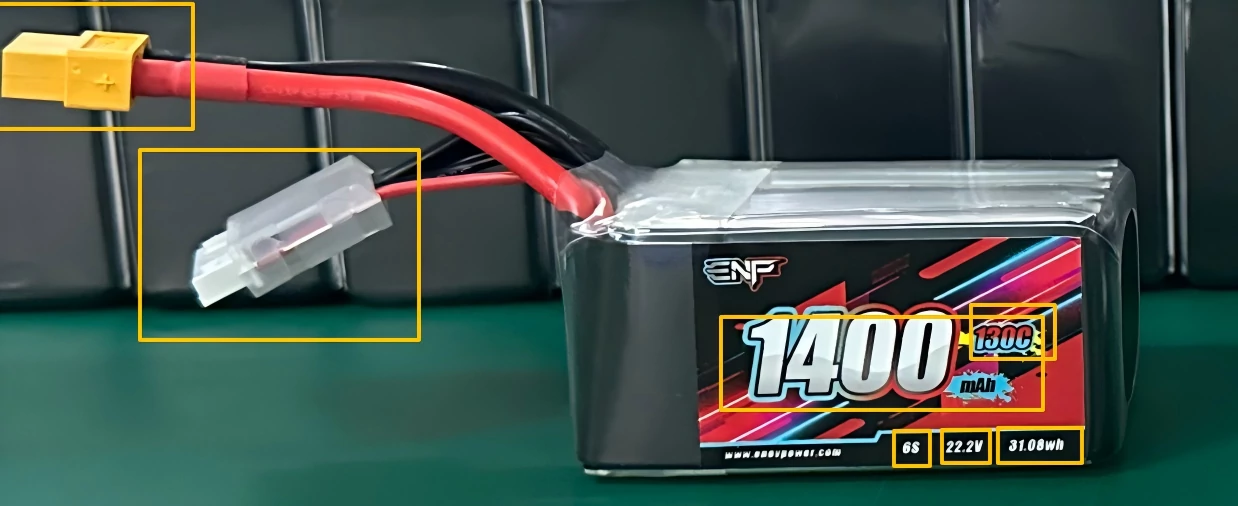
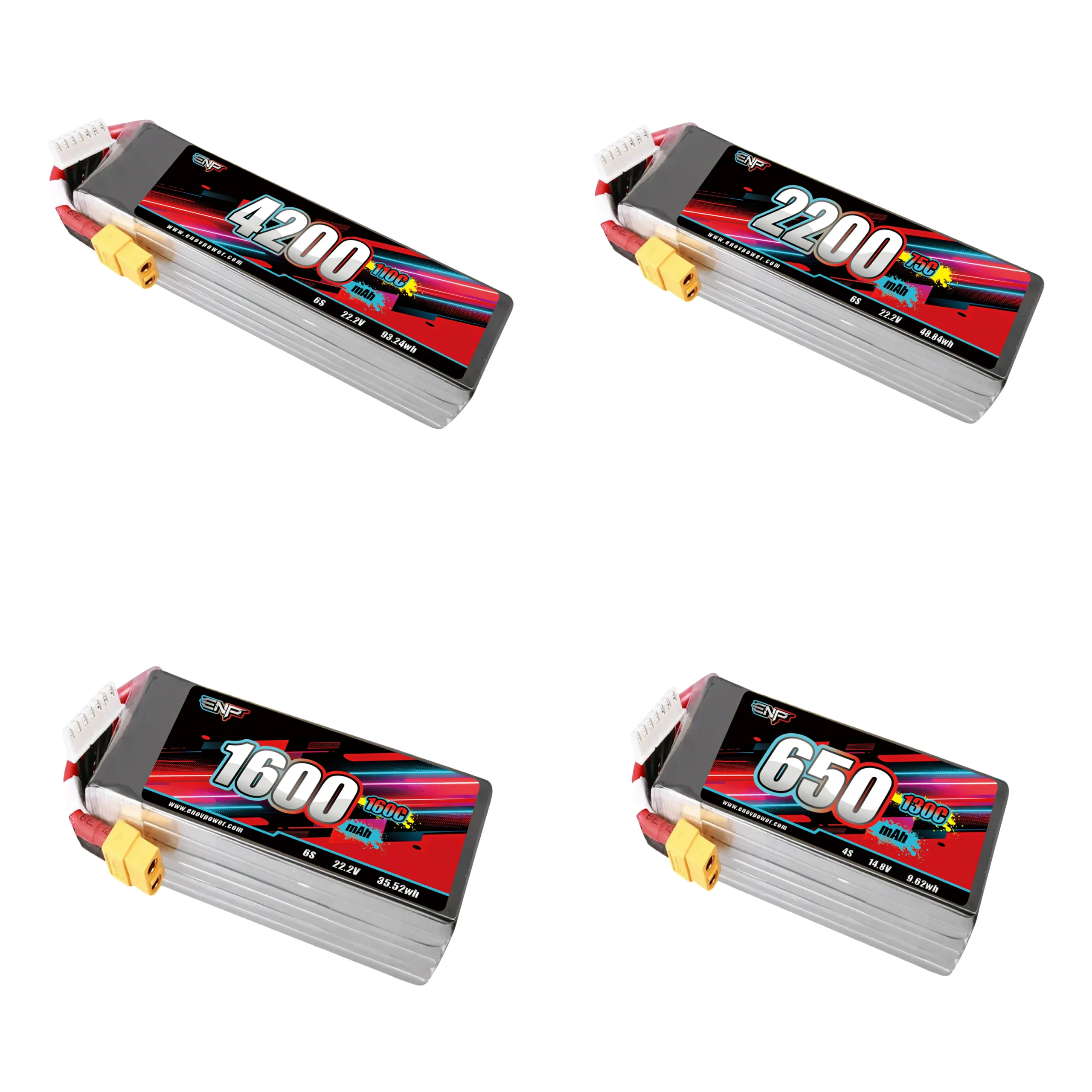
Indoor/outdoor racing, acrobatic flight. For example, ENP 6S 1300mAh and 1500mAh 130C batteries are both equipped with XT60 connectors. |
|
Entry-Level Aerial Photography Drone |
3S-4S |
2200mAh – 6000mAh (e.g., 2600mAh, 3300mAh) |
20C-35C (balancing endurance and power) |
Beginner practice aerial photography, short-distance shooting, compatible with most consumer-grade multi-rotor drones. |
|
Small Industrial Drone (Surveying/Mapping/Inspection) |
4S-6S |
5200mAh – 16000mAh (e.g., 5200mAh, 10000mAh) |
25C-50C (meeting long-time operation and stable power supply needs) |
Small surveying and mapping drones, power inspection drones. |
|
Medium-Load Drone (Training/Small Lifting) |
4S-6S |
16000mAh – 22000mAh (e.g., 22000mAh) |
25C-30C (high capacity and long endurance, adapting to load requirements) |
CAAC training-specific drones, small lifting drones. The 22000mAh 4S battery is paired with an XT60 connector to ensure stable power supply. |
Adaptation Notes: 3 Key Reminders
1. Avoid the “capacity misunderstanding”: Not all high-capacity batteries must use XT60 connectors. Low-power, small-capacity batteries (e.g., 2S 3000mAh 5C) usually use XT30 connectors; similarly, small-capacity, high-rate batteries (e.g., 6S 1300mAh 150C) require XT60 connectors to ensure safety due to their large discharge current.
2. Wire gauge matching affects adaptation effect: The current-carrying capacity of the XT60 connector needs to match the wire gauge. For high-power drones, it is recommended to use 12AWG or 10AWG pure copper/tinned copper wires to avoid local overheating caused by excessive wire resistance.
3. Reject inferior counterfeit products: Counterfeit XT60 connectors mostly use cheap plastic and ordinary terminals, which not only have insufficient current-carrying capacity but also are prone to deformation and damage under high temperature and vibration. It is recommended to choose supporting connectors and batteries from regular brands.
IV. Summary: Application Boundaries and Selection Suggestions for XT60 Connectors
The XT60 connector is the “golden match” for medium and high-power drones with 30-60 amperes, mainly fitting drone batteries with a 3S-6S voltage platform and 1000mAh-22000mAh capacity, covering mainstream models such as FPV racing drones, entry-level aerial photography drones, and small industrial drones. When selecting, there is no need to blindly pursue “high-capacity adaptation”; the key is to match the maximum discharge current of the drone with compliant wire gauge and genuine connectors to balance flight performance and safety.
If your drone is a medium or high-power model, or you are pairing it with a 3S-6S high-rate battery, the XT60 connector is undoubtedly a mature and reliable choice—its high current-carrying capacity, low-loss transmission, and durability are important guarantees for the stable flight of drones.